Opinion: AI Did Not Invent Laziness
July 24, 2026I recently saw a post criticizing conference slides and talks that seemed to be generated with AI: crowded slides, empty language, speakers reading scripts they did not seem comfortable with, and presentations falling apart during questions.
I replied sarcastically that, apparently, before the AI era everybody was doing their most beautiful work and nobody reused the same complicated textbook material in their slides. That was the short version. Here is the longer version of my opinion.
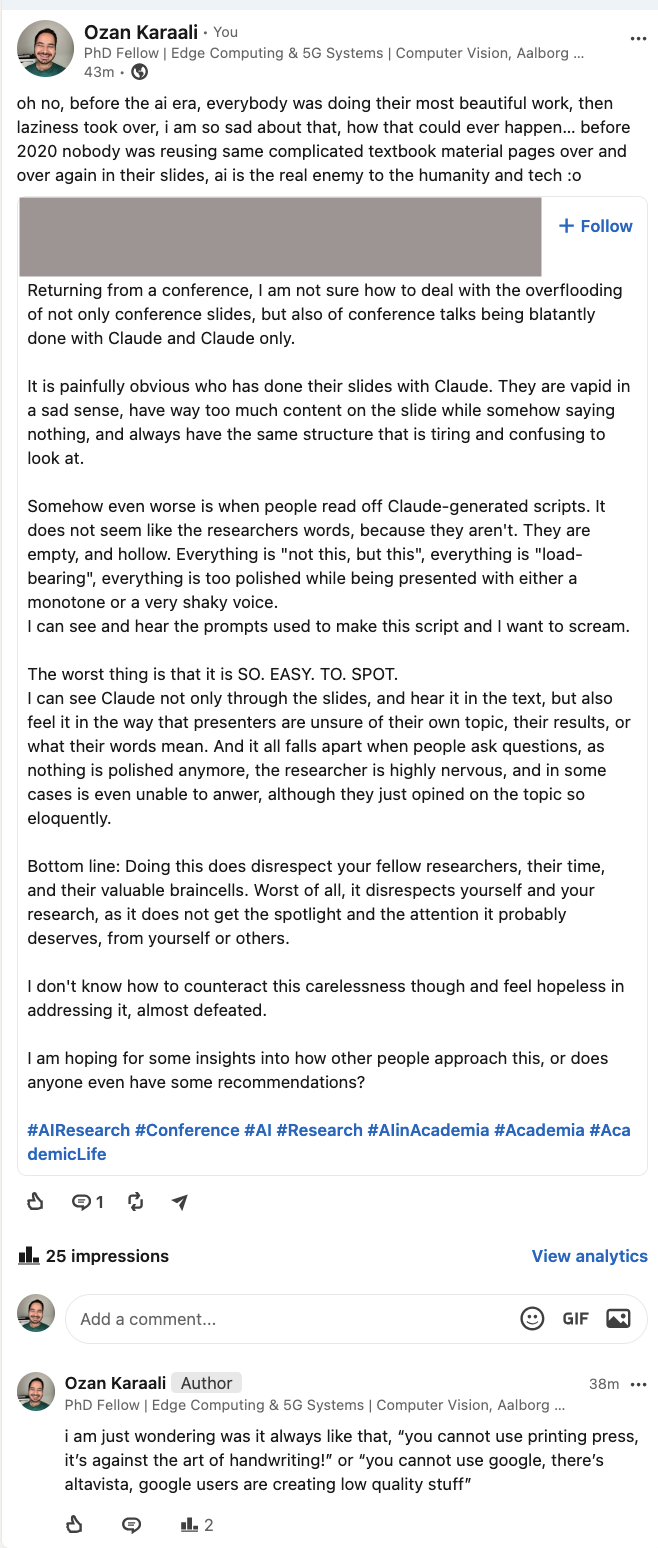
The post and my reply that started this. I removed the person’s name because I have an issue with the idea, not with the person. If they explicitly want to be named here, I can add it.
In this perfect pre-AI world, every conference slide was original. Every speaker knew every detail of the topic. Nobody read from a script. Nobody filled a slide with forty lines of text. Nobody reused the same diagram for the fifteenth year in a row.
Then ChatGPT appeared, laziness was invented, and academia collapsed.
At least, this is the history I am apparently expected to believe.
I remember the world before generative AI. It was not a lost paradise of handmade intellectual craftsmanship. We had unreadable slides, copied figures, inherited templates, meaningless animations, monotone talks, and presenters who could recite a beautiful sentence but could not explain it after one unexpected question. We had people copying from Wikipedia, taking old slides from supervisors, and presenting diagrams they had never really understood.
Universities even had their own pre-AI content-degradation pipeline: photocopy the photocopy, scan it, print it again, and then ask students to interpret whatever survived. The original image might have been useful. After enough generations it became archaeological evidence.
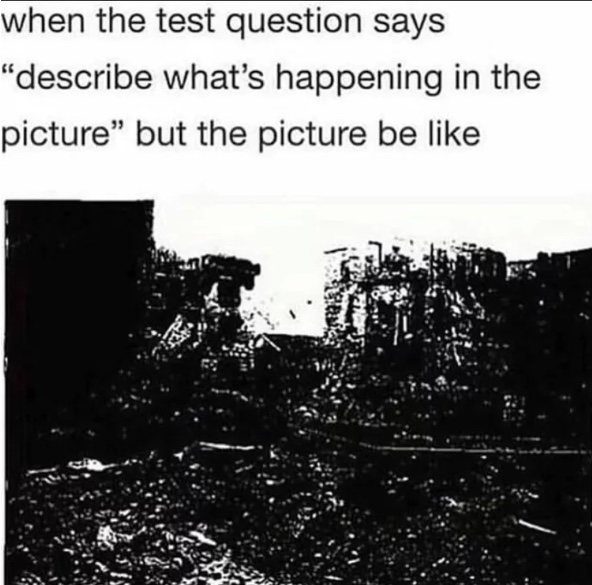
The classic university experience: describe the picture after the picture has lost almost all information. Found via this Reddit post.
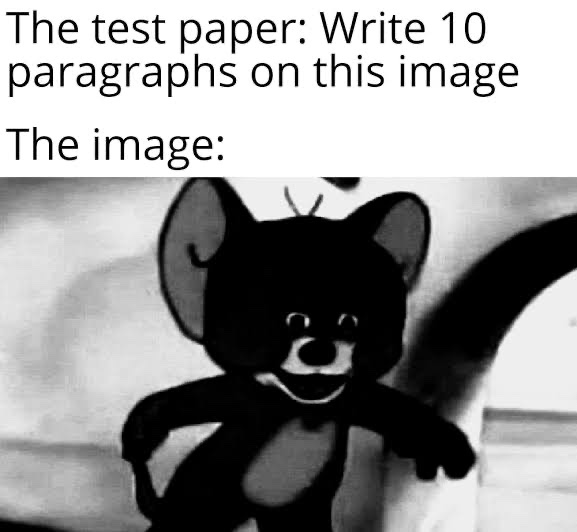
Ten paragraphs, please. The remaining three pixels should be enough. Found via this Reddit post.
Presentation slides were not sacred either. Search almost any technical topic and you can still find decks that put textbook paragraphs on a screen, add arrow-shaped bullets, and call the result visual communication.
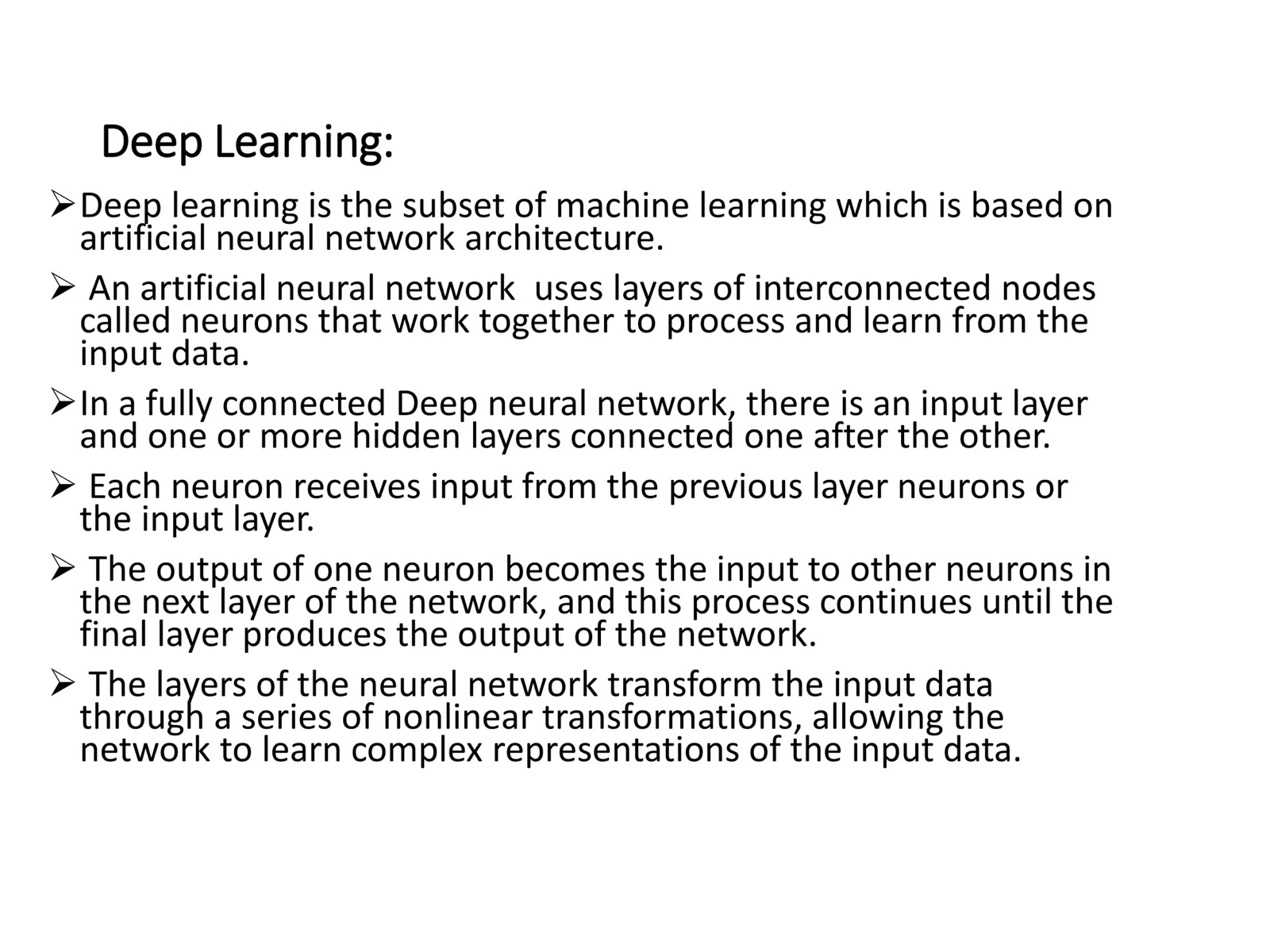
Deep learning explained by filling the screen with text about deep learning. Slide 2 of “Deep learning.pptx” on SlideShare, uploaded by MdMahfoozAlam5.
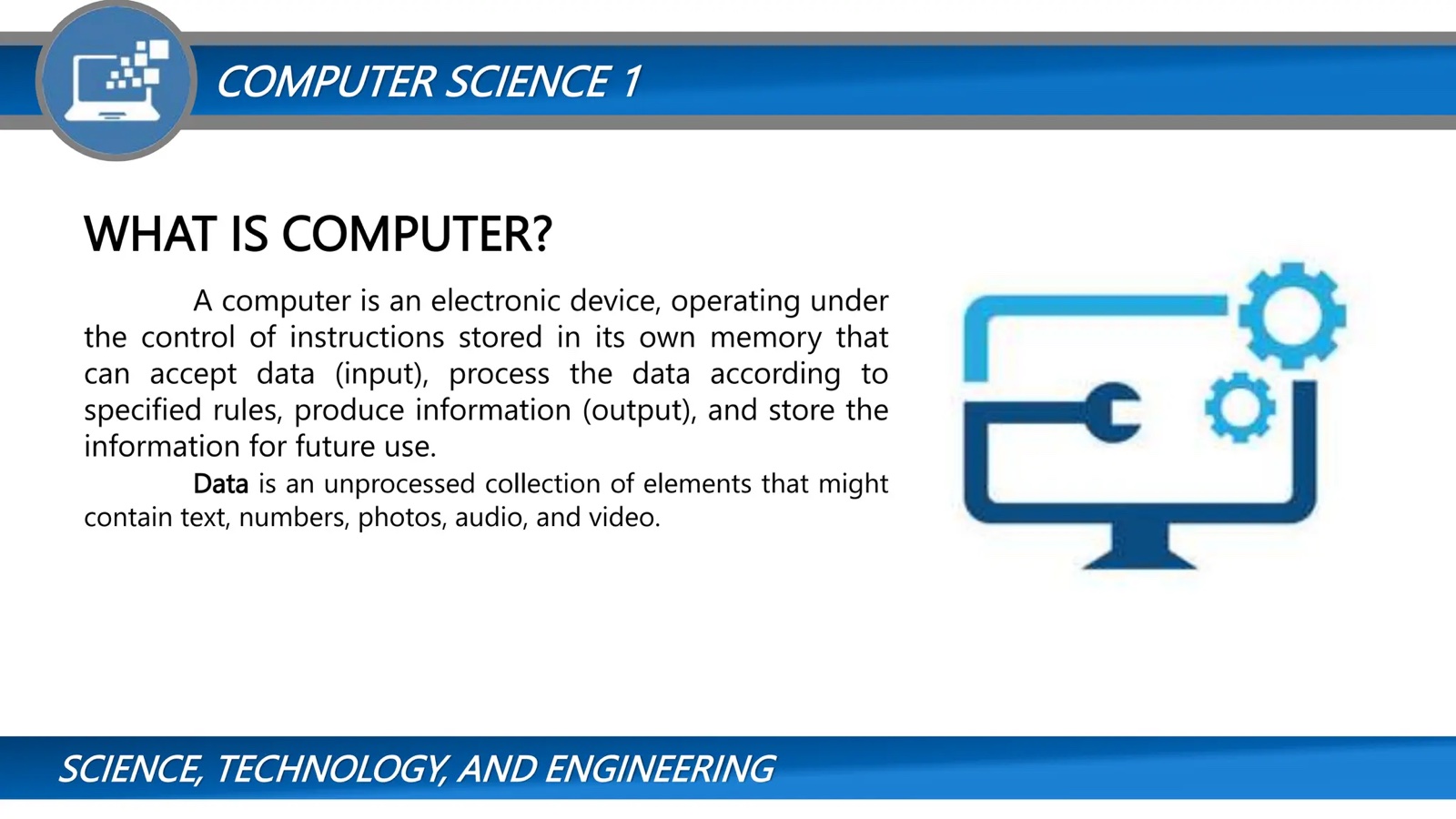
A definition, a generic computer icon, some blue bars, and we have a slide. Slide 4 of “Intro to Computer Science” on SlideShare, uploaded by Harry James Thompson.
None of these examples proves that the teacher or presenter was lazy. That is also part of my point. We can criticize the unreadable image, the wall of text, or the generic visual without turning the tool that produced it into a moral diagnosis.
Low-effort work is older than generative AI.
Yes, bad AI work is bad
Of course vapid AI-generated presentations exist. Of course it is annoying when somebody asks a model for twenty slides, accepts the first output, and walks onto the stage without understanding what is written there. If a researcher reads a generated script without owning the words and then falls apart during questions, that is embarrassing. No disagreement from me.
And yes, I have seen bad AI presentations too. Sometimes the images were so bad that they became funny. They had text errors, anatomy errors, random medical symbols, and this half-skeuomorphic, half-holographic UI style. I do not even know what the correct design term is. It looked like somebody asked a science-fiction film to design a hospital dashboard without ever visiting a hospital.

A skeleton apparently waiting for its AI-assisted consultation. The anatomy, room, interface, and purpose all become more questionable the longer you look. Image file hosted by Auxein.


The classic blue AI-healthcare universe: glossy pseudo-interfaces, decorative symbols, strange spatial logic, and text that almost says something. Image file hosted by IQPC.

These are bad images. I can laugh at them and still use AI. “This image is bad” is a useful criticism because we can point at the broken text, anatomy, composition, or visual language. “AI is bad” does not tell us what to improve.
But what exactly are we criticizing?
The crowded slide? The empty language? The lack of understanding? The careless researcher? Good. Criticize all of those things. They deserve criticism.
The strange jump happens when all of these old human failures are renamed “AI.” Suddenly the tool becomes the moral explanation for the work. A weak presentation is no longer weak because the presenter did not care enough. It is weak because Claude touched it. A familiar phrase becomes forensic evidence. A certain layout becomes a crime scene. People start acting as if they can smell the prompt from the other side of the room.
Maybe they are right sometimes. So what?
If the slide says nothing, explain why it says nothing. If the argument is wrong, show where it is wrong. If the presenter cannot defend the method, ask the technical question and let that become visible. These are real standards. “This looks like AI” is mostly a vibe wearing an academic costume.
I am tired of this AI allergy because it confuses recognition with evaluation. Spotting a writing pattern is not peer review. Guessing which tool produced a sentence is not an assessment of whether the sentence is true.
We have done this before
Every useful tool reduces the effort required to produce something. This also reduces the effort required to produce garbage. The printing press produced more books, including bad books. Search engines made knowledge easier to find, including wrong knowledge. Calculators made arithmetic faster, including calculations based on confidently wrong inputs.
Imagine somebody in 1999 saying, “Google? No, thanks. AltaVista is enough. Yahoo has a human-edited directory. Fuck PageRank and SEO!” It sounds ridiculous now, but the structure is familiar. A new tool becomes popular, lazy people use it lazily, and then the laziness is blamed on the tool.
No, a language model is not literally the same thing as a printing press or a calculator. That is not the point. The recurring mistake is treating lower effort as lower value by definition. We should care about the result, the process where it matters, and the responsibility of the person putting their name on the work.
AI can make me faster. It can also help me make mistakes faster. Fine. I remain responsible for both.
Let us run the ridiculous experiment
Sometimes I want to take the anti-AI argument completely seriously and split research into two imaginary communities.
The first community protects intellectual purity. No language models. No generated code. No AI-assisted literature discovery. Then the arguments begin: Is grammar correction allowed? Is autocomplete allowed? What about a search engine with an AI summary? What about software that quietly uses machine learning? They can create committees to inspect the borders. They can examine slide layouts and debate whether a phrase feels suspiciously Claude-like.
The second community uses every tool it can get. It also keeps one boring rule: researchers remain accountable. Verify the citations. Check the proof. Run the experiment. Understand the code. Answer the questions. If the model invents something, your name is still on the mistake.
Now wait ten years and compare the two.
Which community do we expect to advance faster?
While one side is discussing whether a bullet list has the spiritual fingerprint of generative AI, people on the other side are already using agents to attack Erdős problems and the Jacobian conjecture while watching the World Cup.
This is not hypothetical anymore. In May 2026, an internal OpenAI model produced a counterexample to Erdős’s unit-distance conjecture. OpenAI published the original announcement and proof, then a group of external mathematicians published a human-verified companion paper. Will Sawin later gave an explicit quantitative refinement. The model found the construction; humans checked it, simplified it, explained it, and extended it. That seems much more useful than inspecting whether the prose describing it feels suspiciously AI-like.
A few months later, Levent Alpöge posted an explicit three-variable polynomial map, credited Akhil Mathew for asking about the problem, and credited Fable for working during the World Cup final.
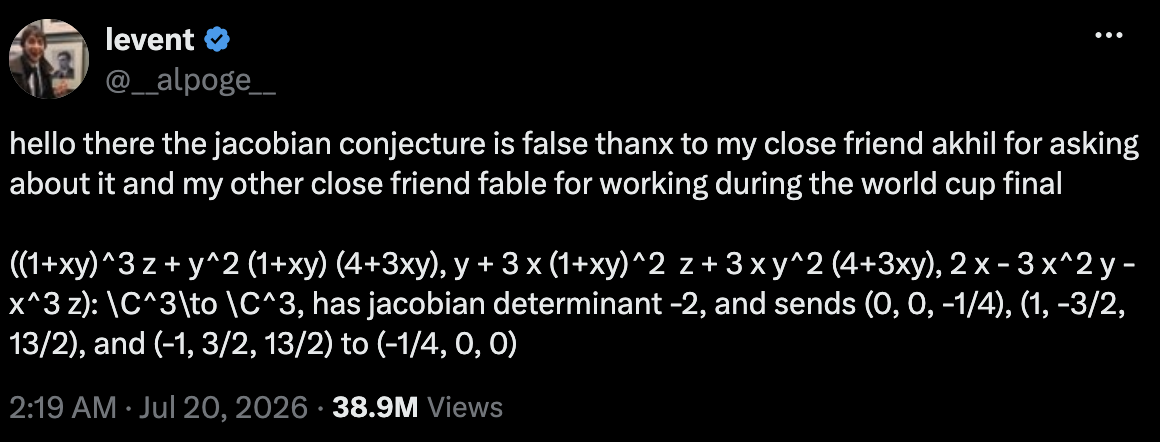
The original X post was followed by an algebraic verification, an independent Isabelle/HOL formal verification, and separate Lean verification. The counterexample disproves the Jacobian conjecture in dimension three and, by adding unchanged coordinates, every dimension above it. Dimension two remains open.
While I was writing this, Dmitry Rybin also posted a small claimed counterexample to the Dinitz–Garg–Goemans conjecture, found through four prompts to GPT-5.6 Pro. The shared conversation includes an explicit seven-node graph and a finite routing certificate. It looks directly checkable, but I have not found an independent formal verification yet, so I am calling this one a recent claim rather than a settled result.
Maybe the agents fail. Most ambitious attempts fail. But they can test more directions, inspect more connections, and remove more mechanical work from the humans trying to think.
This is deliberately exaggerated, obviously. I am not requesting two physically separated academic civilizations. I am saying that tool purity has an opportunity cost, and pretending otherwise will not make it disappear.
If somebody truly believes that AI involvement makes research illegitimate, I would honestly like to see the consistent version of that position. Build the AI-free community. Define the rules. Then let both approaches produce work, solve problems, train researchers, and face reality. I think everybody already knows how that comparison will develop.
We can extend the experiment to journals. Create explicitly non-AI journals. Authors cannot use AI. Editors cannot use AI. Reviewers cannot use AI either, including for summaries, language checks, literature searches, or drafting comments. Fine. Let us see how that system behaves.
The funny part is that the reviewer can still be grumpy. A paper can still be rejected because somebody misunderstood it, defended their territory, disliked the framing, let personal bias affect the judgment, or simply had a bad day. How many papers were treated unfairly before AI because humans are humans? We talk as if removing AI returns us to some neutral and perfectly rational baseline. That baseline never existed either.
The human still has to be there
Here I should be honest too: I sometimes lose track of my own work now. I can have several workers exploring code, reading papers, testing ideas, or preparing different parts at the same time. That creates a coordination problem that did not exist when I could only do one thing at a time.
There is another uncomfortable part. The world notices every productivity increase and immediately raises the expected output. Work that could have been a full thesis years ago is now expected to fit inside one paper. Work that once took years starts getting requested within a week. We gain tools that can multiply our effort, and almost instantly that multiplication becomes the new minimum.
It is a little like the Industrial Revolution, unfortunately. Better machinery did not simply give everybody free time. It changed the scale, speed, organization, and expectations of production. AI is doing something similar to knowledge work. One researcher can now coordinate a small number of digital workers, but then that researcher needs the habits of a team lead: notes, checkpoints, verification, provenance, and sometimes the discipline to stop opening new threads.
Using AI is not a permission slip for intellectual absence. If you cannot explain your own method, the problem is yours. If you cite papers that do not exist, the problem is yours. If your presentation is polished but empty, the problem is yours. The model does not stand at the podium and receive the questions. You do.
That is exactly why I find the anti-AI framing so frustrating. It gives careless people a convenient excuse. Instead of saying, “I did not understand my own presentation,” we can say, “AI made presentations bad.” Instead of teaching better verification, better speaking, and actual ownership, we perform detective work on fonts and sentence patterns.
I do not want lower standards because AI exists. I want higher standards that make sense in a world where it exists.
Ask whether the claim is supported. Ask whether the experiment can be reproduced. Ask whether the researcher understands the choices. Ask whether the work contributes something. Ask the difficult question after the talk and listen to the answer.
And if you want to criticize laziness, criticize laziness. Do not rename it “AI” merely because the newest tool makes an ancient human habit easier to notice.